

Have you ever wondered why a new white T-shirt looks whiter under sunlight than under indoor light, or why premium plastic packaging has a crisp, cool-white appearance? The answer often lies in a family of additives called optical brighteners, also known as fluorescent whitening agents (FWAs) or fluorescent brightening agents (FBAs).
These additives do not bleach, dye, or pigment a product. Instead, they make materials appear brighter by converting invisible ultraviolet (UV) light into visible blue light. The result is a cooler, cleaner white that the human eye reads as brighter and fresher. For manufacturers of detergents, textiles, paper, and plastics, optical brighteners are a cost-effective way to enhance perceived quality without increasing pigment loading.
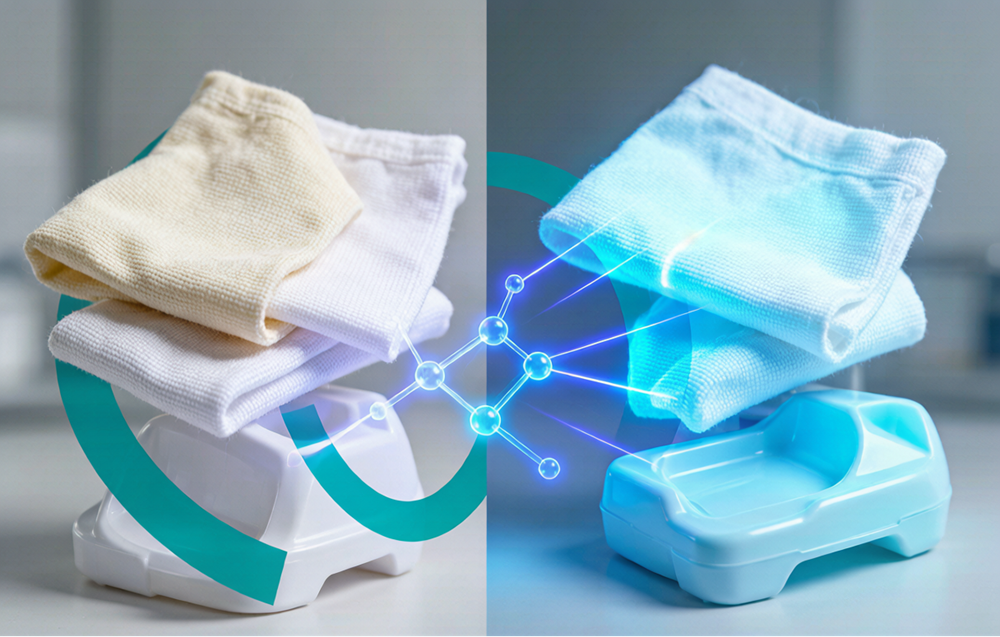
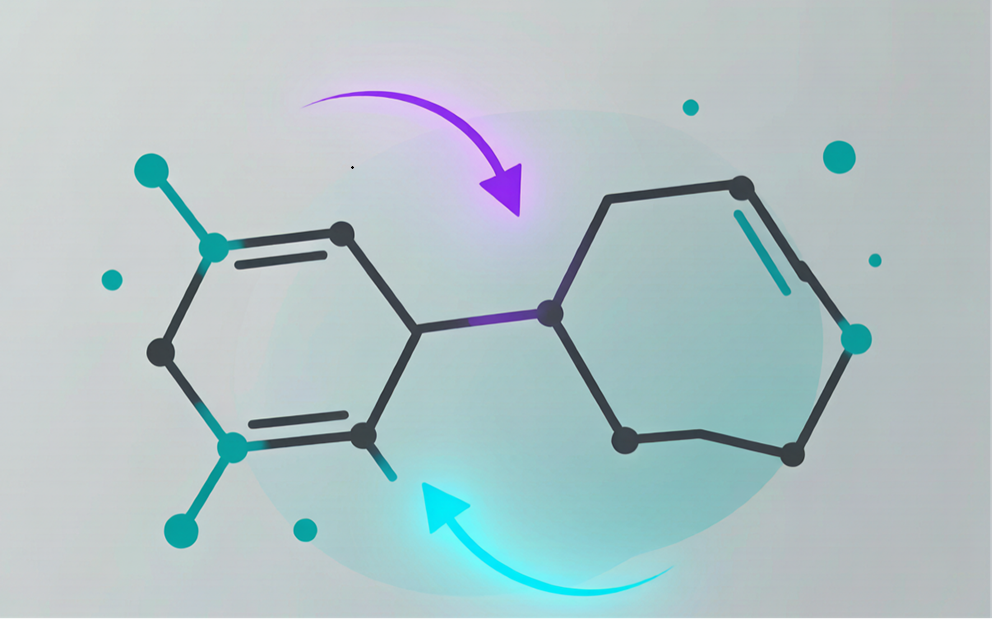
Optical brighteners are organic compounds with extended conjugated double-bond systems, usually based on stilbene, coumarin, benzoxazole, or pyrazoline derivatives. When embedded in a matrix such as a detergent powder or a plastic compound, these molecules absorb UV radiation in the 300-400 nm range and re-emit it as blue-violet light in the 400-500 nm range.
This emitted blue light compensates for the yellow or brown tones that naturally develop in fibers and polymers over time due to oxidation, heat, or UV exposure. Because yellow and blue are complementary colors, the added blue cancels out the yellow cast, making the substrate look neutral white or even slightly bluish-white.
In household and industrial laundry products, optical brighteners are one of the most widely used appearance-enhancing additives. They deposit onto fabric during the wash cycle and remain bound to fibers through multiple rinses. When the wearer steps into daylight, the UV component of sunlight activates the brightener, making the garment appear whiter and brighter.
For detergent formulators, selecting the right optical brightener means balancing several factors:
- CBS-X (Tinopal CBS-X) — A common choice for liquid detergents and cold-water formulations, valued for solubility and compatibility with anionic surfactants.
- Color safety — Important for colored fabrics, where excess blue can shift shade; modern brighteners are designed to enhance whiteness without dulling colors.
- Wash-fastness — Brighteners must remain effective through repeated washing and drying cycles to justify their cost.
- Environmental profile — Increasingly, formulators want biodegradable or lower-environmental-impact options that still deliver strong brightening.
Optical brighteners are equally important in the plastics industry. They are used in polyolefins (polyethylene and polypropylene), polystyrene, PVC, engineering plastics, and synthetic fibers to improve whiteness, mask yellowing from processing, and create a premium visual finish.
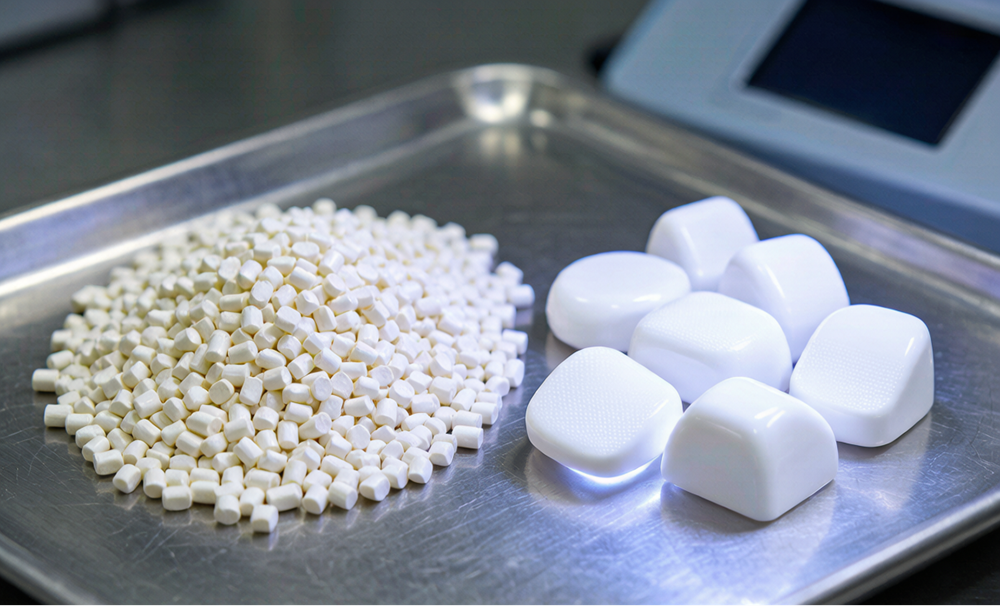
Plastic processors typically add optical brighteners as a masterbatch or as a direct powder/compound additive. The right grade must survive melt-processing temperatures, distribute uniformly in the polymer matrix, and resist migration or blooming to the surface. Common applications include:
- Food packaging and films where shelf appeal depends on a bright white base.
- Consumer goods including appliance housings, electronic enclosures, and automotive interior trim.
- Fibers and textiles such as synthetic yarns and nonwovens where whiteness is a key quality metric.
- White masterbatches where brighteners are combined with TiO2 to maximize opacity and whiteness at lower pigment cost.
Not all optical brighteners perform the same way. For B2B buyers evaluating suppliers, here are the most important technical considerations:
- Emission spectrum — Different brighteners absorb and emit at different wavelengths. For cool whites, a strong violet-blue emission is preferred. For warmer whites, a slightly greener emission may be better.
- Heat stability — In plastics, the brightener must withstand extrusion or injection-molding temperatures without decomposing or discoloring.
- Light and oxidation resistance — Brighteners can be sensitive to UV and oxidizing conditions. A high-quality product maintains its effect over the intended product lifetime.
- Compatibility and dispersion — The brightener must disperse uniformly and not interact negatively with other additives such as antioxidants, UV absorbers, or pigments.
At Nanjing Reborn New Materials Co., Ltd., we supply optical brighteners for detergent, textile, paper, and plastic applications. Our portfolio includes high-performance grades suitable for liquid and powder detergents, polyolefin masterbatches, PVC profiles, and synthetic fiber production.
We understand that optical brightening is not a one-size-fits-all solution. Substrate, processing conditions, end-use environment, and regulatory requirements all influence the optimal choice. Our technical team works with customers to recommend the right grade, dosage level, and formulation approach to achieve the desired whiteness and long-term stability.
Post time: Aug-13-2026