

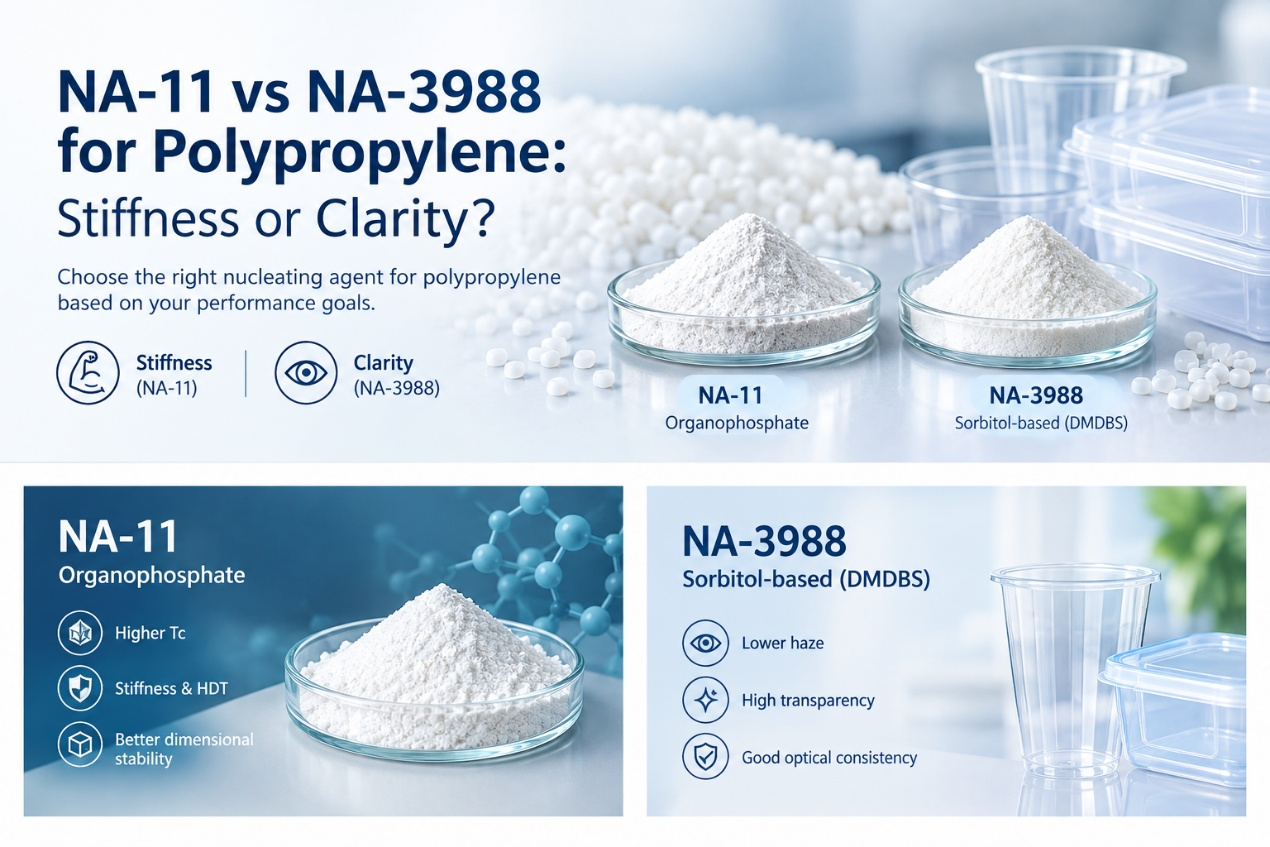
- • Need higher flexural modulus, heat distortion temperature (HDT), and dimensional stability? Start with NA-11.
- • Need lower haze and higher transparency in clear PP packaging or medical components? Start with NA-3988.
- • Need both rigidity and transparency? Evaluate both in the actual PP grade rather than assuming one additive will optimize every property.
Core Objectives in PP Modification: Mechanical Rigidity vs. Optical Clarity
Polypropylene is widely used in thin-wall injection molding (TWIM), household products, food packaging, medical disposables, and industrial components. However, its mechanical and optical properties depend strongly on its crystalline morphology.
A suitable nucleating agent for polypropylene provides additional sites for crystal formation, influencing crystallization temperature, crystal size, and the final balance of stiffness, shrinkage, and transparency.
NA-11 and NA-3988 both promote crystallization, but they use different chemical mechanisms to achieve different performance priorities. NA-11 is generally the stronger starting candidate for rigidity-focused formulations, whereas NA-3988 is usually preferred when optical clarity is the leading requirement.
Mechanism of Heterogeneous Nucleation: Shifting Crystallization Temperature (Tc)
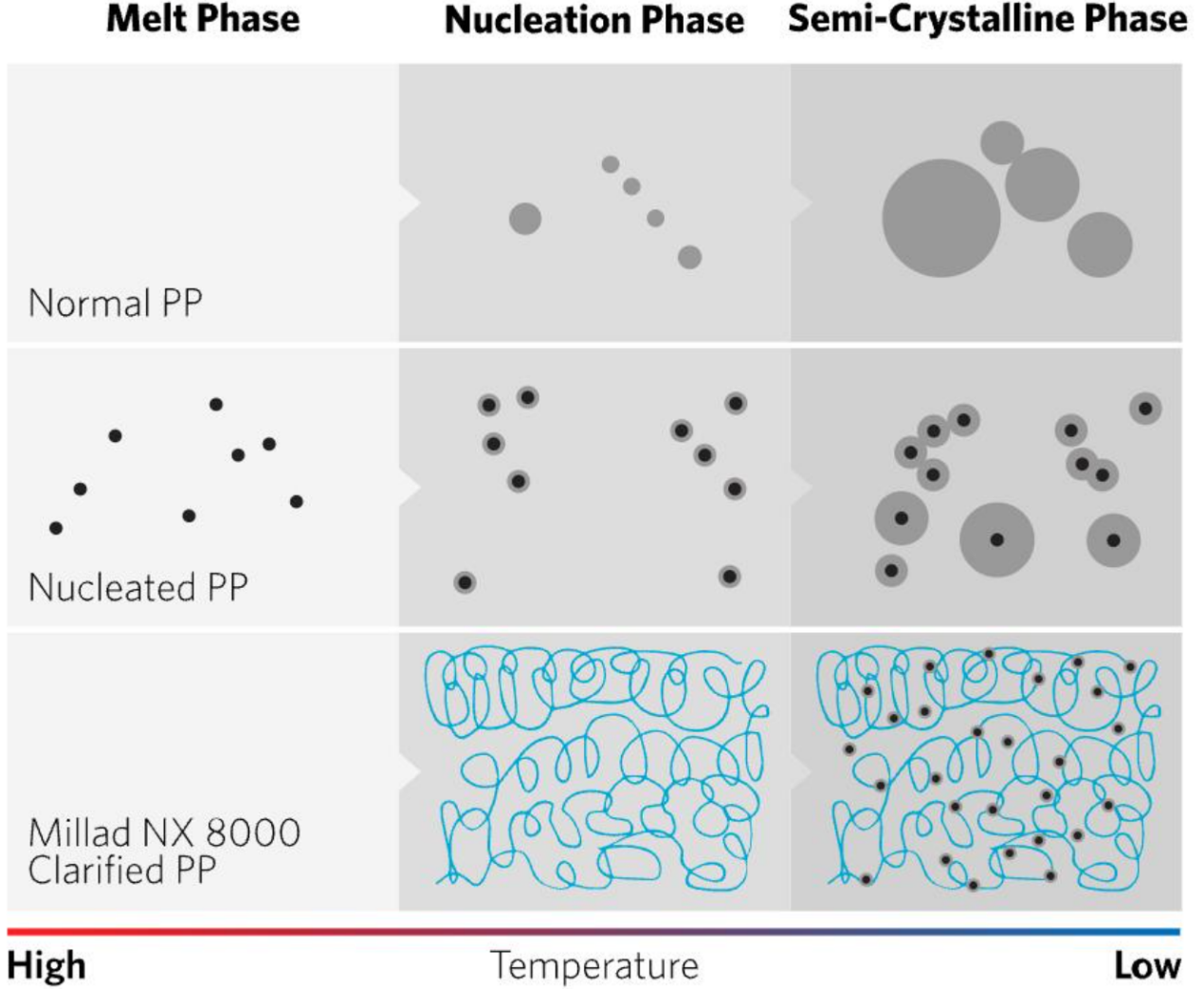
Unmodified PP crystallizes as the melt cools. Without sufficient nucleation sites, crystallization may begin at a relatively low temperature, and the polymer can develop comparatively large spherulites.
- Earlier crystallization during cooling, potentially supporting shorter molding cycles.
- Greater control over crystalline morphology and dimensional stability.
- Changes in mechanical properties, including stiffness and heat resistance.
- Reduced optical scattering when a suitable clarifying mechanism produces sufficiently fine morphology.
A published study of DMDBS in isotactic PP reported an increase in crystallization peak temperature from 118.7°C to 130.1°C at a cooling rate of 10°C/min with 0.2 wt% additive. See the published DSC study.
Defining the Trade-off: Flexural Modulus and HDT vs. Haze Reduction (ASTM D1003)
Flexural modulus measures resistance to bending. A higher value generally indicates greater stiffness under the specified test conditions. HDT measures the temperature at which a specimen reaches a defined deformation under a specified load.
Optical performance requires a different evaluation. Haze describes the scattering of transmitted light that reduces visual clarity, while luminous transmittance measures the proportion of incident light transmitted through a specimen. Both can be evaluated using ASTM D1003.
Organophosphate NA-11: Maximizing Spherulite Density, Stiffness, and Dimensional Stability
NA-11 is identified as sodium 2,2′-methylene-bis-(4,6-di-tert-butylphenyl)phosphate, CAS No. 85209-91-2. Its key potential advantages include:
Sorbitol-Based Clarifier NA-3988 (DMDBS): Nanofibrillar Network for Premium Optics

NA-3988 is particularly suitable for applications such as transparent food packaging, medical disposables, and clear molded articles. Its distinguishing value proposition is optical clarity rather than maximizing stiffness alone.
Test Methods Checklist
| Performance target | Recommended evaluation | What to compare |
|---|---|---|
| Crystallization behavior | DSC cooling cycle | Crystallization onset and peak temperature |
| Stiffness | Flexural testing (ASTM D790) | Flexural modulus and strength |
| Heat resistance | HDT testing (ASTM D648) | Deflection temperature |
| Transparency | ASTM D1003 | Haze % and luminous transmittance |
Technical RFQ & Procurement Checklist
- Target PP grade: Homopolymer, random, or impact copolymer.
- Priorities: Rigidity, impact strength, transparency, or cycle time.
- Specifications: Required haze, flexural modulus, and HDT levels.
- Regulatory: Food-contact (FDA/EU) compliance requirements.
- Processing: Melt-temperature window and equipment type.
Conclusion: Which Nucleating Agent Should You Choose?
Choose NA-11 when stiffness, HDT, and dimensional stability are the leading objectives.
Choose NA-3988 when low haze and high transparency are the primary objectives.
Nanjing Reborn New Materials Co., Ltd. supports PP modification projects with nucleating-agent options for different performance targets.
Post time: Oct-28-2026