

Industrial baking finishes are judged on volatile organic compound (VOC) content, curing energy, chemical resistance and exterior durability at once — all settled upstream, in the choice of a melamine crosslinker for baking coatings. A fully alkylated hexamethoxymethylmelamine (HMMM) and a partially methylated high-imino resin share one triazine core yet behave as different molecules on the line: one cures by transetherification with polyol hydroxyls and needs strong acid; the other self-condenses and cures fast with little or no catalyst.
Chemical Structure & Specification Comparison: DB303 LF vs. DB325
Evaluating a melamine crosslinker for baking coatings starts with the triazine substitution pattern of the methylated melamine resin: the balance of methoxymethyl ethers against imino (–NH) and methylol (–CH2OH) groups fixes the mechanism, catalyst demand and attainable network density.
⚙️Monomeric Hexakis(methoxymethyl)melamine (HMMM) DB303 LF: High Solids (>98%) & Low Free Formaldehyde
The DB303 LF amino resin is a fully methylated HMMM: all six triazine positions are capped as methoxymethyl ethers, with essentially no imino or methylol left. It is monomeric and delivered at ≥98% non-volatile — the workhorse for high-solids, low-VOC systems.
- • Mechanism: ether-only reactivity, so cure proceeds solely by acid-catalysed transetherification with acrylic, polyester or alkyd hydroxyls; one ether per hydroxyl, methanol is the leaving alcohol.
- • Why it matters: negligible self-condensation yields an ether-linked network that is flexible, tough, overbake-tolerant and non-yellowing.
- • Trade-offs: strong acid is mandatory, conventional bake is 150–180 °C/20–30 min, and low melt viscosity invites sag on verticals.
- • Formaldehyde: typically ≤0.5%, ≤0.3% in LF grades — low, not zero; residual methanol counts in odour and VOC terms.
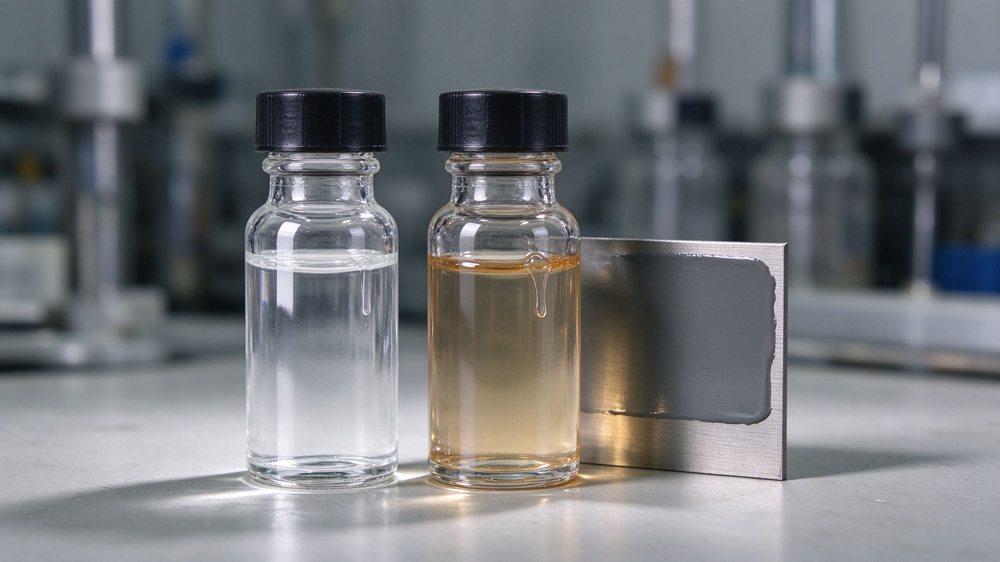
Figure 1 Amino resin samples: water-clear low-free-formaldehyde HMMM (left) and amber high-imino grade (right), with a coated steel test panel.
⚡High-Imino Methylated Amino Resin DB325: Partial Methylation, Fast Self-Condensation & High Reactivity
Methylation is deliberately partial: the DB325 melamine crosslinker retains a substantial imino population alongside methoxymethyl and a small methylol fraction, supplied at ~80% non-volatile in isobutanol.
- • Mechanism: imino condenses with a neighbouring methylol or methoxymethyl, forming methylene and methylene-ether bridges with no external polyol — self-condensation dominates.
- • Response: usable cure at 120–140 °C/20–30 min with weak acid or none; a strong-acid dose reaches 110 °C at the cost of pot life in hours, and the denser network brings higher hardness and solvent, chemical, block and print resistance.
- • Trade-offs: more brittle (T-bend and impact fall), cracks instead of degrading on overbake, higher formaldehyde and methanol evolution, and residual imino groups leave the film moisture-sensitive and the package prone to drift.
Table 1 Representative specification ranges for DB303 LF and DB325; confirm current values on the supplier TDS and each lot COA.
| Parameter | DB303 LF (HMMM) | DB325 (high-imino) |
|---|---|---|
| Substitution | Fully methylated, ~6 methoxymethyl | Partial, imino + methylol retained |
| Non-volatile | ≥98% | ~80% in isobutanol |
| Free formaldehyde | ≤0.5% (≤0.3% LF) | ~0.5–1.5% |
| Self-condensation | Negligible | Dominant |
| Catalyst | Strong acid, 0.3–1.0% on binder | None to weak, 0–0.3% |
| Bake | 150–180 °C/20–30 min; coil PMT 232–260 °C | 120–140 °C/20–30 min |
| Film | Flexible, non-yellowing, durable | Hard, chemically resistant, brittle |
| Best fit | OEM topcoat/clearcoat, coil, low-VOC | Primers, sealers, low-bake, high-build |
Formulation Boundary Conditions: Catalysis, Curing Temperature & Resin Compatibility
The catalyst package is where most failures of a melamine crosslinker for baking coatings begin: too little acid passes the oven, then fails the solvent rub; too much is hard on day one and delaminates after humidity. Catalysts come from the coating additive range; the dose is set by cure-response data, not habit.
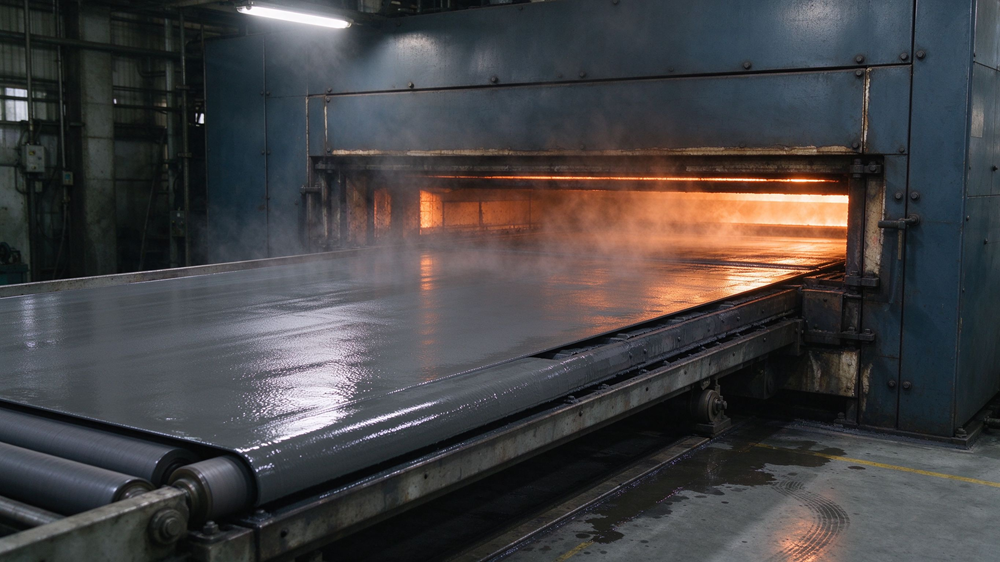
Figure 2 Coated steel strip leaving a continuous bake oven; the cure window is set by oven residence time and peak metal temperature.
Strong Acid Catalysis (PTSA / DDBSA) Requirements for DB303 LF in High-Bake Systems
- Dosage: 0.3–1.0% p-TSA on binder solids; 0.5–1.5% DDBSA where the lipophilic tail keeps the acid in solution in low-aromatic, high-solids systems.
- Blocking: amine-blocked p-TSA (AMP, TEA, oxazolidine) buys months of one-pack shelf life but imposes a hard condition — the oven must peak 15–20 °C above the unblock temperature, or the acid never becomes available and cure stalls mid-film.
- Setting the level: acid demand scales with hydroxyl value, film thickness, substrate heat sink and air flow, and is suppressed by basic pigments and fillers. Build a cure-response curve (MEK rubs versus bake temperature, 120–180 °C in 10 °C steps, per catalyst level); the plateau is the usable window. Over-catalysis costs flexibility, adhesion and exterior durability, because residual sulfonic acid drives hydrolysis.
Weak Acid / Uncatalyzed Curing Mechanism and Fast Low-Temperature Response of DB325
DB325 crosslinks itself, so amino resin curing conditions shift: imino–methylol condensation releases water, methanol and formaldehyde and needs no external hydroxyl.
- Where it wins: energy-constrained gas ovens at ~130 °C, short-residence coil lines, and primers that must not overbake the sealer beneath them; phosphoric esters or amine salts trim another 10–15 °C.
- Caution one: unreacted imino groups are hygroscopic and hydrolytically labile — a film deliberately undercured for flexibility will swell, blush and lose adhesion in a humidity cabinet.
- Caution two: crosslink density is set by the resin-to-polyol ratio, not hydroxyl stoichiometry, so the optimum is narrower than most formulators expect; past it, brittleness becomes the failure mode.
Compatibility with Hydroxyl Acrylic, Saturated Polyester, and Alkyd Backbones
- Hydroxyl acrylic (OH 90–150 mg KOH/g, Tg 30–60 °C): DB303 LF is the standard for OEM topcoat, clearcoat, refinish clearcoat and appliance finishes, preserving gloss, DOI and colour; DB325 suits the same acrylics where hardness or lower bake leads — typically primers and mid-coat.
- Saturated polyester (OH 60–120 mg KOH/g): HMMM wins on flexibility — coil coatings surviving a 1T–2T bend after a 232–260 °C PMT bake are almost always HMMM-based — while DB325 fits polyester primers and can coatings where solvent and pasteurisation resistance outrank post-formability.
- Alkyd: both improve hardness and dry-through, but alkyd acid value is a built-in catalyst — high-acid alkyd plus DB325 can gel in the package. Check acid value first.
- Ratio: 15:85 to 35:65 on solids; HMMM’s ~65 g per methoxymethyl equivalent means even 20:80 exceeds the hydroxyl demand, and the surplus sets crosslink density, flexibility and cost.
Laboratory Screening & Cured Film Performance Evaluation
A melamine crosslinker for baking coatings is validated by a short, repeatable test set that separates cure deficiency from chemistry mismatch.
MEK Double Rub Resistance, Pencil Hardness, and Flexibility Testing
- MEK double rubs (ASTM D5402): solvent-loaded cloth, firm pressure, 50 or 100 rubs; report breakthrough numerically, never pass/fail. Expect ≥100 for DB303 LF at 160 °C/20 min with 0.6% p-TSA, 150–200 for DB325 at 130 °C/25 min; under 50 at the specified bake means undercure, not a bad resin.
- Pencil hardness (ASTM D3363, 750 g, gouge and scratch): HMMM lands at H–2H, high-imino at 2H–3H on the same polyol.
- Flexibility (ASTM D522 mandrel/T-bend, ASTM D2794 reverse impact): the ranking inverts — HMMM tolerates 1T–2T and high impact, DB325 often cracks at 2T–3T.
- Diagnosis: soft plus flexible = undercure; hard plus cracking = over-crosslink or excess melamine ratio. Cross-hatch adhesion after 240 h humidity (D3359/D2247) is the tie-breaker: loss with good MEK resistance means acid over-catalysis.
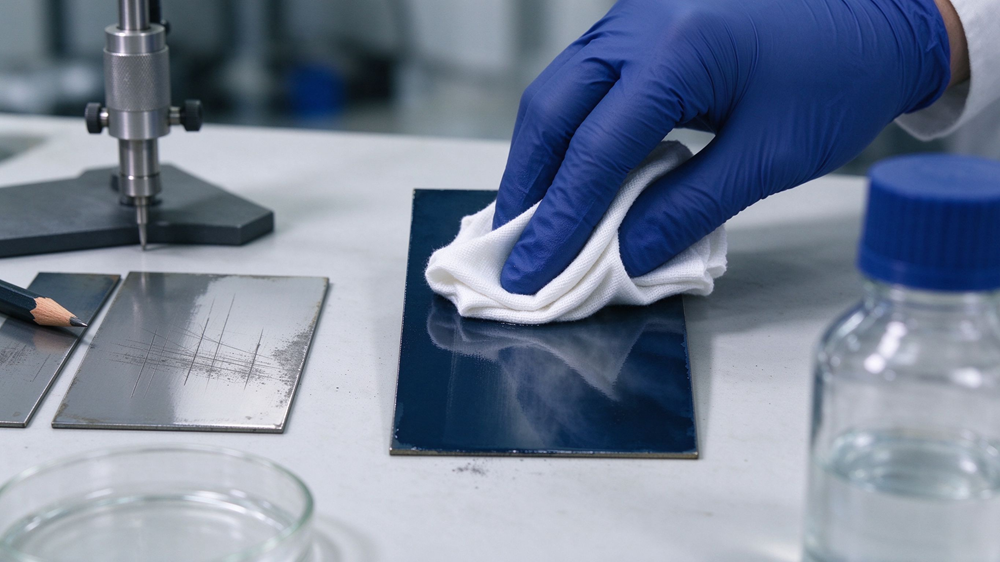
Figure 3 MEK double rub on a cured film, with pencil-hardness panels alongside; the solvent rub screen separates undercure from chemistry mismatch.
Table 2 Screening matrix for baked films; report breakthrough and cracking numerically rather than as pass or fail.
| Test | Method | DB303 LF | DB325 | Failure diagnosis |
|---|---|---|---|---|
| MEK double rubs | D5402 | ≥100 | 150–200 | <50 = undercure |
| Pencil hardness | D3363 | H–2H | 2H–3H | Soft + flexible = undercure |
| T-bend / mandrel | D522 | 1T–2T | 2T–3T | Cracking = over-crosslink |
| Reverse impact | D2794 | High | Moderate | Low with high hardness = brittle |
| Adhesion + humidity | D3359/D2247 | Good | Good | Loss with good MEK = excess acid |
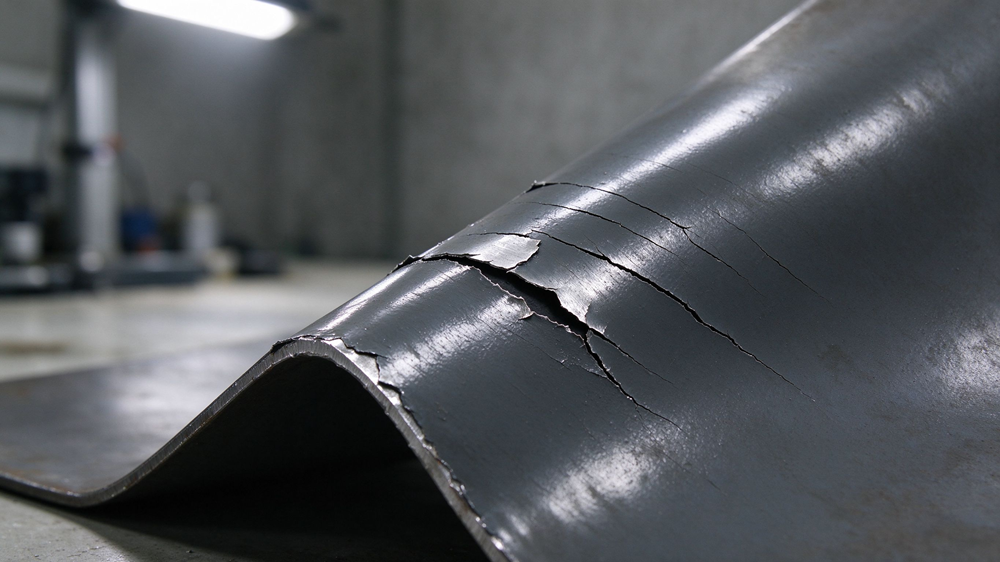
Figure 4 Cracking and flaking on the outside of a bend; high crosslink density buys hardness and solvent resistance at the cost of flexibility.
Pot Life, Package Viscosity Stability, and Low-VOC Compliance
- DB303 LF, catalysed one-pack: usable viscosity for 24–72 h at 25 °C, Ford cup climbing then gelling. Add catalyst last, and use blocked acid if the plant cannot guarantee same-day consumption.
- DB325, uncatalysed: stable for months in a sealed drum below 30 °C; with acid added, pot life collapses to hours and warm storage accelerates gelation and formaldehyde drift.
- VOC arithmetic: at ≥98% solids, DB303 LF takes a high-solids polyester to 250–350 g/L without exotic solvents, anchoring low-VOC and waterborne-colloid systems; DB325 enters at ~80% solids, so ~2.4 lb/gal of isobutanol lands in the VOC figure before thinning — but it gives lower application viscosity at equal solids, which high-build primers and sealers need.
Sourcing Checklist & Technical Verification for Buyers
Buying a melamine crosslinker for baking coatings is a specification exercise, not a price comparison: the COA and the TDS carry almost all the risk, and both are routinely accepted without the checks that prevent a line failure.
Post time: Nov-10-2026