

Technical guidance for liquid detergent formulators — Nanjing Reborn New Materials Co., Ltd.
Adding an optical brightener cbs-x in liquid detergent systems looks simple: disperse a water-soluble fluorescent whitening agent (FWA) into a surfactant blend and let the fabric do the rest. In practice the matrix is hostile. A 3× compact may carry 30–50% surfactant and 1–5% electrolyte — an ionic-strength regime far from the deionised water behind a supplier’s solubility curve, where a material dispersing at 0.1% can still crystallise or dull in a 40 °C warehouse. This checklist splits the evaluation into four gates — photophysics, matrix compatibility, stress testing and co-additive synergy. Scope caveat: the supplier’s published application list names soaps, laundry pastes and washing powders, with no liquid detergent claim, so every liquid-specific figure below is a test agenda, not a transferred result.
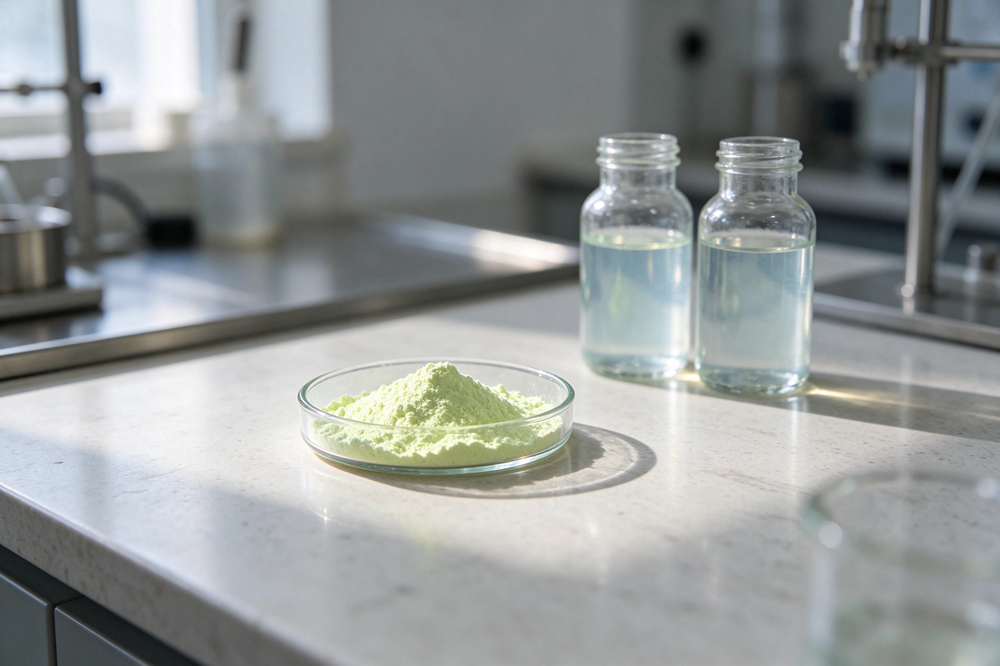
Key Technical Challenges of Optical Brighteners in Liquid Formulations
Brighteners fail in ways rarely visible on day one: a batch can pass release at 0.06% and still show a blue-grey film six months on shelf.
Distilbene Biphenyl Structure: Optical Absorption (340–360 nm) & Violet-Blue Fluorescence (430–440 nm)
CBS-X (disodium 4,4′-bis(2-sulfonatostyryl)biphenyl, MW 562.6, CAS 27344-41-8) is a distyrene-biphenyl FWA whose planarised π-system absorbs near-UV light at 340–360 nm and re-emits in the violet-blue at 430–440 nm. On fabric it offsets the yellow cast of aged cellulose and lifts the whiteness index without chemical bleaching.
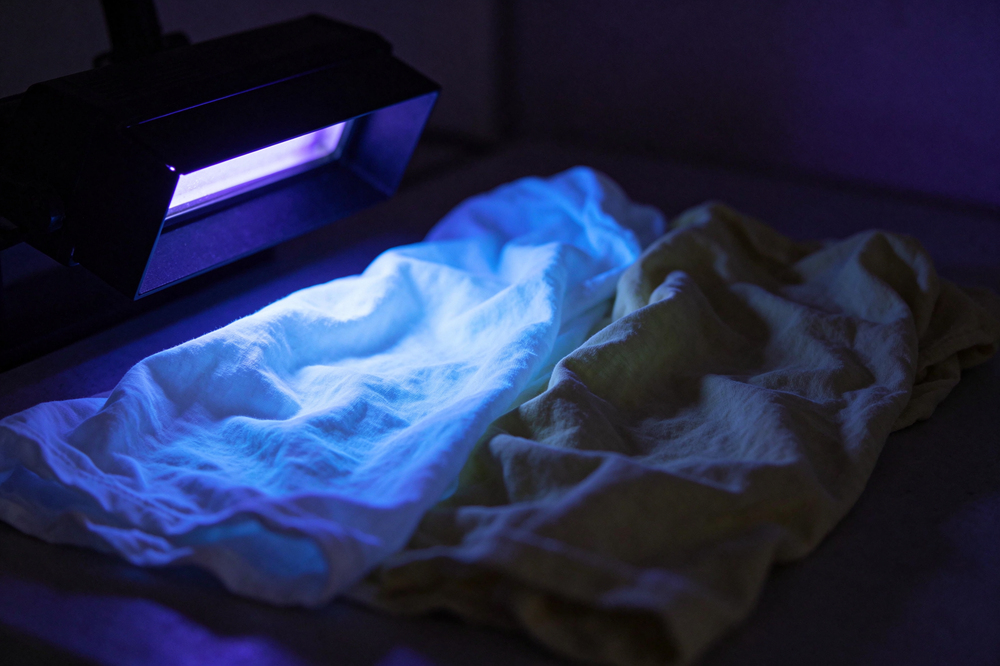
Figure 2. Whitened cotton under 365 nm UV beside an untreated swatch: the visible lift is a violet-blue optical effect, so only an instrumented whiteness reading is a valid endpoint.
The chromophore is sensitive to its optical environment: anything absorbing in the same near-UV window — certain UV absorbers, some perfume aldehydes, amber packaging — competes for excitation energy and reduces the visible effect. Fluorescence is also quenched by collisional contact, so overdosing does not simply “add more white”; beyond fibre saturation the excess stays in the liquor and deposits unevenly. Only an instrumental reading (CIE Whiteness Index or Ganz-Griesser) is therefore a reliable endpoint.
Raw Material Solubility vs. Thermodynamic Stability in Concentrated Surfactant Matrices
The sulfonate groups make the sodium salt freely dispersible in water, but dispersion is kinetic; crystallisation is thermodynamic. In a compact liquid free water may be only 45–55% of the formula, much of it bound in micelles and hydration shells. As water activity falls and electrolyte rises, the effective solubility product drops: at low temperature the active can exceed saturation and nucleate on the bottle wall or at the micelle interface; at elevated temperature it associates with the anionic palisade layer and separates later as a cloudy ring.
Treat solubility as a matrix property, not a datasheet property. Published solubility is 25 g/L at 25 °C against a recommended dosage of 0.04–0.2% (w/w): at the top of that range in a formula that is half water, the water-phase concentration reaches roughly 4 g/L, about one-sixth of saturation before electrolyte and cold storage. Titrate upward in 20% increments from the intended level: the headroom between working dose and first haze is the real formulation tolerance. Grade and diluent matter too: Optical Brightener CBS-X supplied as a standardised sodium salt behaves differently from a lower-assay technical grade carrying sulfate residues that add ionic strength. Charge interaction compounds the risk: anionic CBS-X forms insoluble complexes with cationic surfactants, quaternary softeners or polyamine modifiers — even 0.2% cationic carry-over can leave a grey precipitate reading as “dirt” on the bottle base.
Compatibility Screening & Formulation Stability Testing Protocol
For an optical brightener cbs-x in liquid detergent work, the screen must follow real base architecture rather than a generic “detergent base”. Run three variants — high-anionic AES/LAS, anionic/non-ionic hybrid with 3–5% AEO, and a low-surfactant economy base — each spiked at target dose plus one 50% overdosed condition; the overdose locates where tolerance ends.
Surfactant Compatibility & pH
With AES and neutralised LAS, CBS-X is expected to be compatible. High LAS nonetheless raises the Krafft point; very high AES at low electrolyte gives viscosity that traps particles. pH 7–9 is the practical buffer band. Below pH 7, acid-catalysed isomerisation accelerates; above pH 9, the risk shifts to alkaline degradation.
Freeze-Thaw & Drift
Three to five cycles from −5 °C to 45 °C. Measure turbidity, pH, and viscosity. A drift beyond ±15% signals micellar restructuring. Accelerated storage at 40 °C for 8 weeks catches slow crystallisation. Add hydrotropes (propylene glycol) to widen the solubility window.
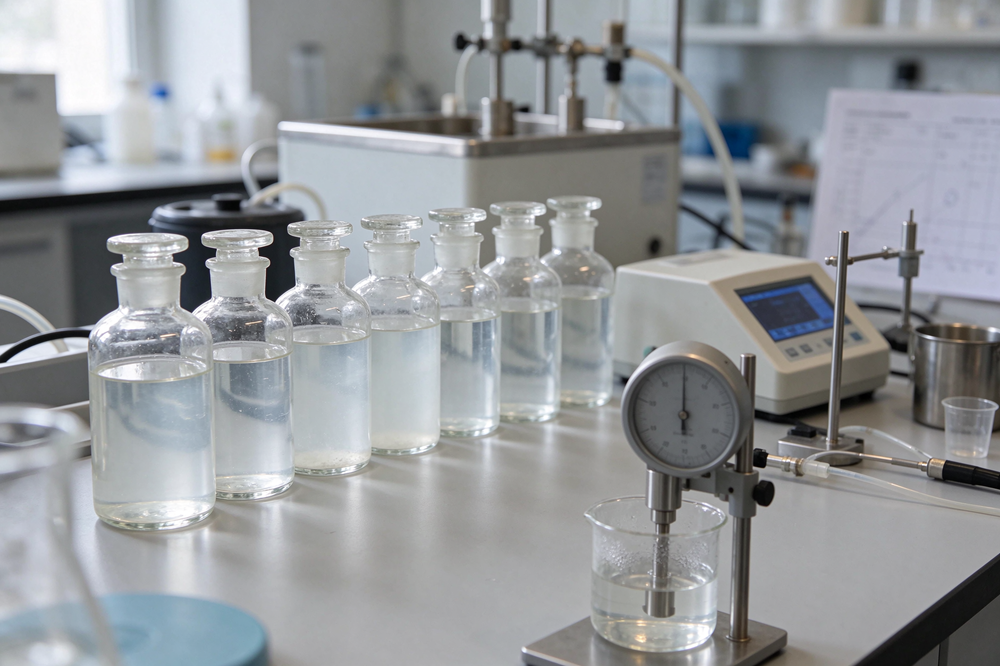
Figure 3. Freeze–thaw and accelerated-storage samples beside turbidity and viscosity measurement: haze, viscosity drift and b* have to be read together.
Chlorine Bleach Resistance and Light Fastness in Transparent Packaging
Chlorine resistance is relative — available chlorine and contact time decide whether it holds. Test at use dilution and measure residual liquor fluorescence. Light is the second stressor: transparent packaging lets near-UV reach the liquid. Protection is packaging-led — UV-blocking or opaque white HDPE is preferred. Where transparency is required, use a UV absorber in the bottle wall rather than in the formula.
Synergistic Functional Additives in Premium Liquid Laundry Formulations
Preventing Multi-Color Cross-Contamination with Dye Transfer Inhibitor DB-66K
Fugitive dye deposits as a grey-pink haze no brightener can mask. A colour-care polymer such as DB-66K color care additive sequesters hydrolysed dye in the liquor. Confirm charge compatibility: non-ionic or weakly anionic polymers coexist well with CBS-X.
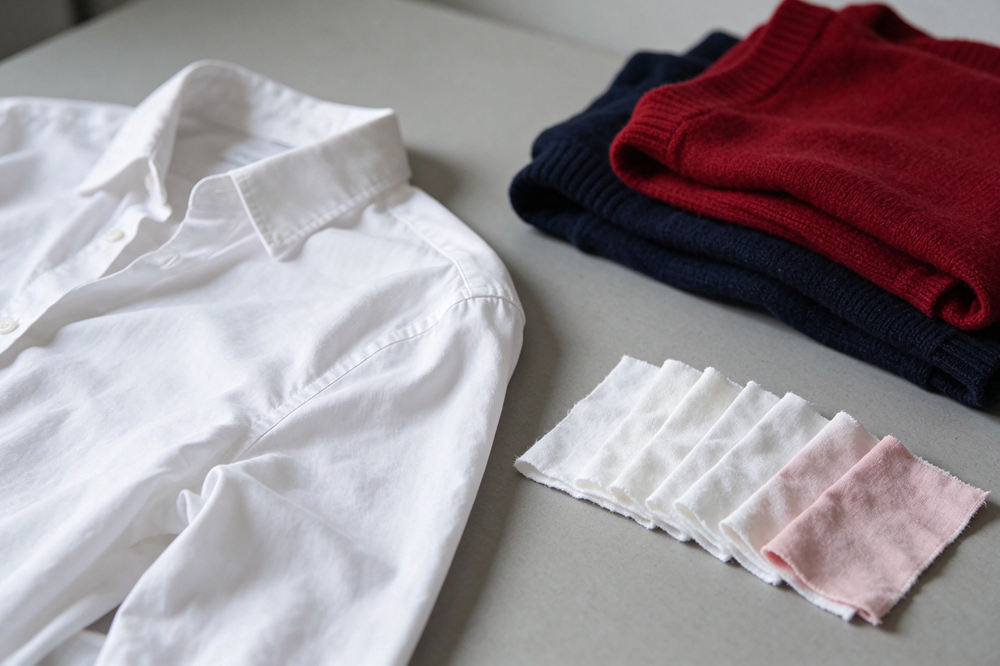
Figure 4. Multi-colour load with a white control and a swatch series showing the dye-transfer gradient: a brightener cannot mask additive colour.
Enhancing Whiteness Retention with Anti-Soil Redeposition Polymer DB-20
Whiteness loss over repeated washes is largely redeposition. An anti-redeposition polymer such as DB-20 anti-redeposition agent keeps fine particulate suspended. Evaluate in a five-cycle repeat-wash test. Screen the ternary combination too: some polymers raise viscosity and lower water activity.
Sourcing Specifications & Sample Benchmarking Checklist
Active Content Purity & Extinction Coefficient
Require assay by UV spectrophotometry. Specify residual limits: sulfate and chloride, water-insoluble matter, and heavy metals (iron and copper). Request a full spectrum, not a single-point assay — a shoulder or shifted maximum exposes isomer or degradation content.
How to Request Formulation Samples
Benchmarking is faster with application context: dose curves, solubility data, and light-fastness summaries. To start, ask about CBS-X formulation samples with a sample sized for a full stability series.
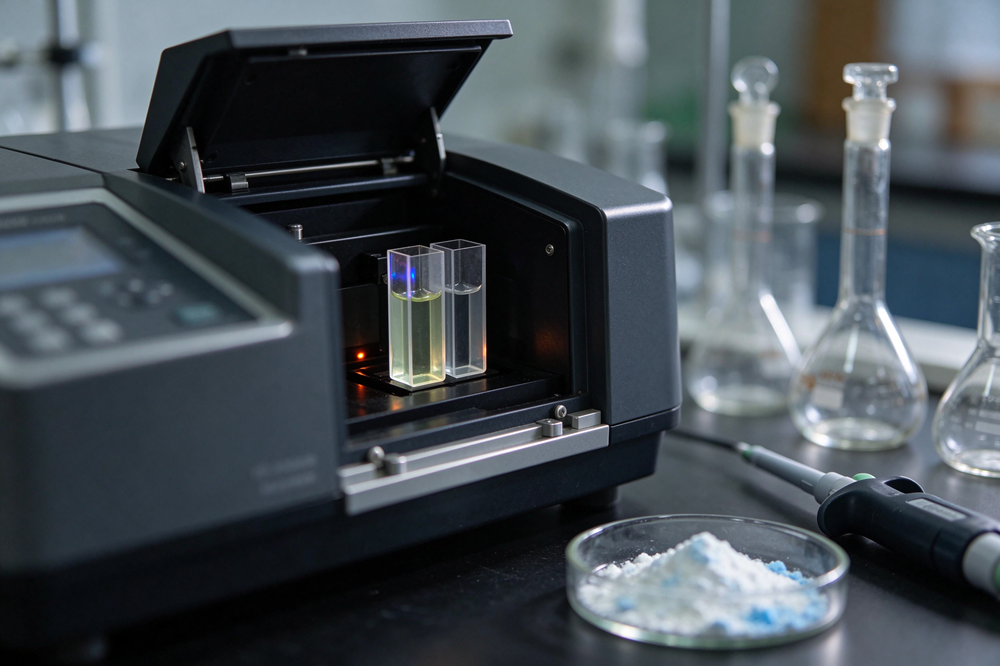
Figure 5. UV-Vis assay of the brightener: the E value plus a full spectrum, not a single-point figure, is what makes lots comparable.
Conclusion: Validating the Brightener Inside the Formula
An optical brightener cbs-x in liquid detergent systems earns its place only when the formulation, not the datasheet, proves it. Work the four gates in order: confirm the photophysics, quantify the saturation margin, stress the prototype, and test synergy with dye-transfer and anti-redeposition polymers. Keep dose below the measured margin, hold pH inside 7–9, and block near-UV at the bottle wall. Until that validation closes, a liquid-detergent whiteness claim is a hypothesis, not a shelf promise.
Post time: Nov-16-2026